



AI is getting better at recognising symptoms. So what should diagnosticians learn?
By Karolina Ziegart-Sadowska7 min read
Will artificial intelligence replace diagnosticians? The question comes up more and more often in conversations about the future of psychology and psychiatry, and it is easy to see why. AI models can already analyse case descriptions, identify symptoms and propose diagnoses. In some tasks they reach results comparable to those of early-career clinicians.
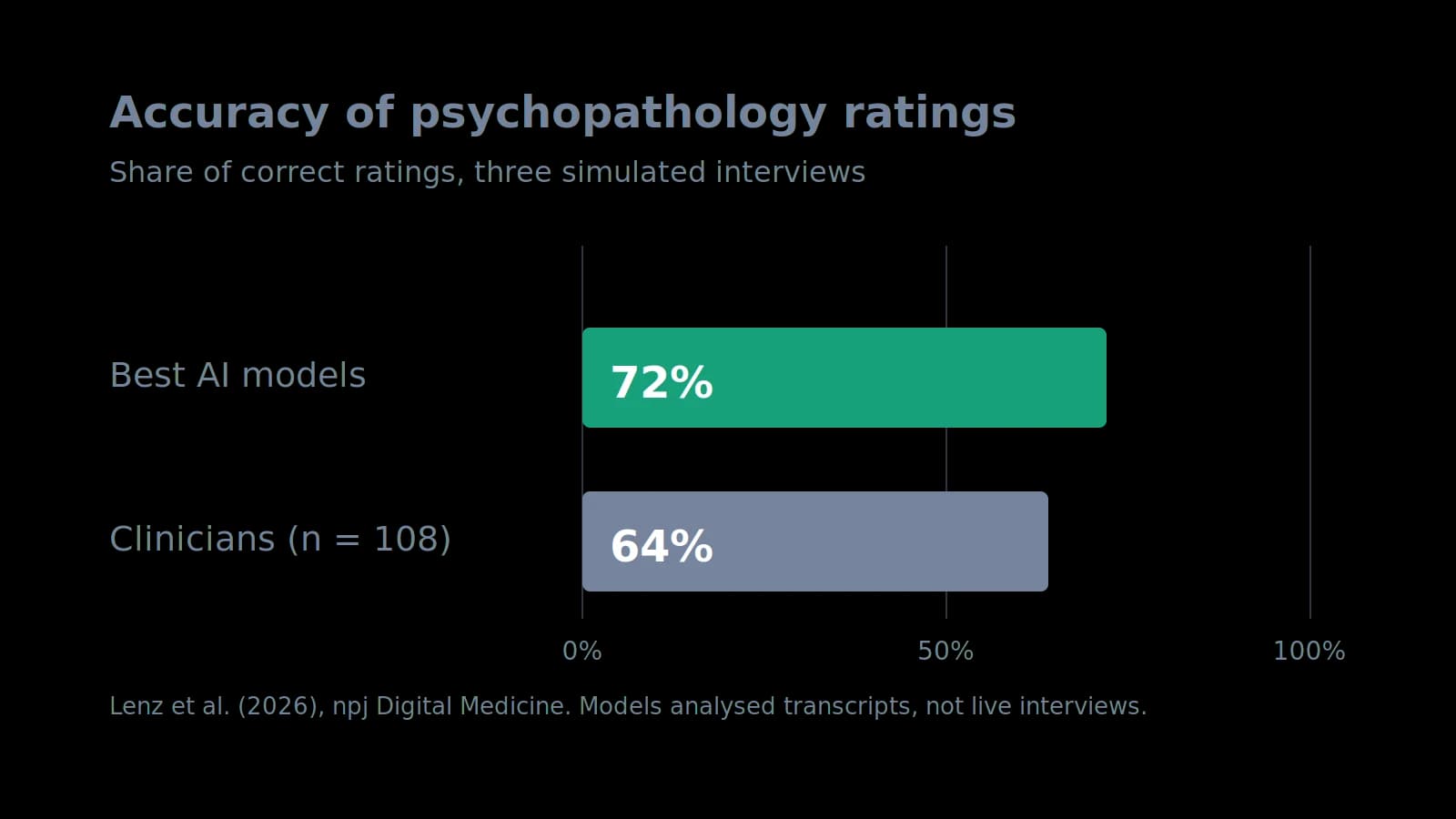
Lenz et al. (2026), published in npj Digital Medicine, compared ten AI models with the ratings of 108 clinicians. The best models reached 72% accuracy in rating psychopathological symptoms, higher than the 64% of the specialists. However, the study covered only three simulated interviews, and the models analysed their transcripts. It did not test whether they can run a full diagnostic process on their own.
Still, we can expect that more and more tasks involving organising information, analysing symptoms and checking diagnostic criteria will be supported or automated by AI.
What does this mean for people who diagnose? Perhaps it is worth looking at which competencies actually make up good diagnostic practice.
Recognising symptoms is only the beginning
Imagine an adult who reports trouble concentrating, organising daily duties and regulating emotions. They often put tasks off, forget agreements and struggle to meet deadlines. Many of these experiences resemble the symptoms of ADHD.
You can run an interview focused on the diagnostic criteria, establish which of them are met and form a preliminary hypothesis. But a sound diagnostic process requires much more.
When did the difficulties begin? Were they already present in childhood? How has this person's functioning changed over different periods of life? Do the concentration problems occur all the time, or do they get worse mainly under stress? What roles do sleep, anxiety, low mood or chronic overload play?
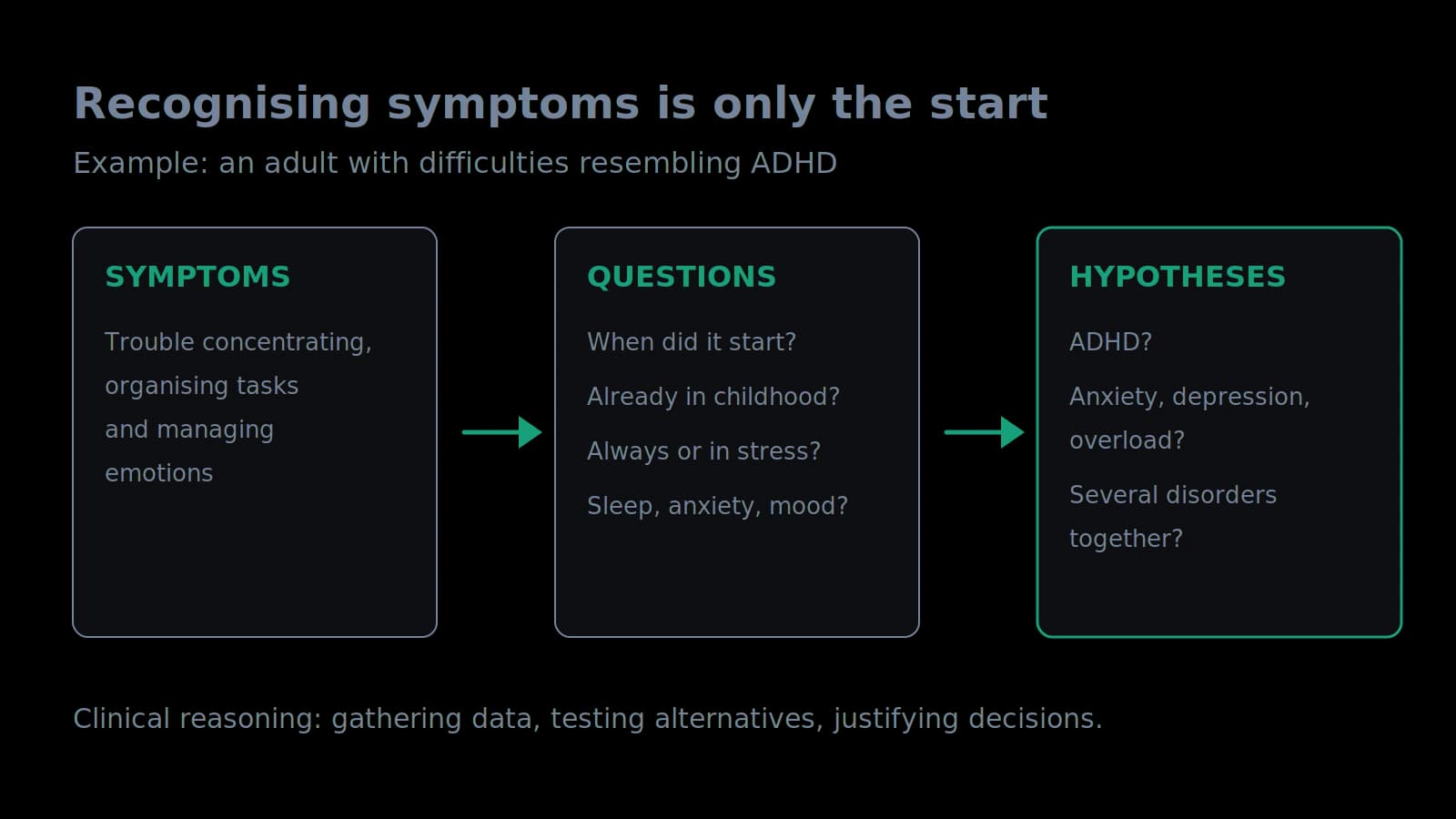
What matters is not only looking for information that confirms ADHD, but also checking other possible explanations, including several disorders occurring together. This approach is in line with the NICE guideline (2018), which stresses the need to consider developmental history, functioning in different areas of life and other mental and neurodevelopmental difficulties.
This is exactly where the difference between recognising a pattern of symptoms and clinical reasoning becomes visible.
Sarma et al. (2026) brought interesting results: language models analysed psychiatric case descriptions. The best model identified 76.7% of the correct diagnoses, but it also proposed many diagnoses that were not accurate. Its positive predictive value was only 40.4%. After expert-knowledge decision trees were added to the process, it rose to 65.3%.
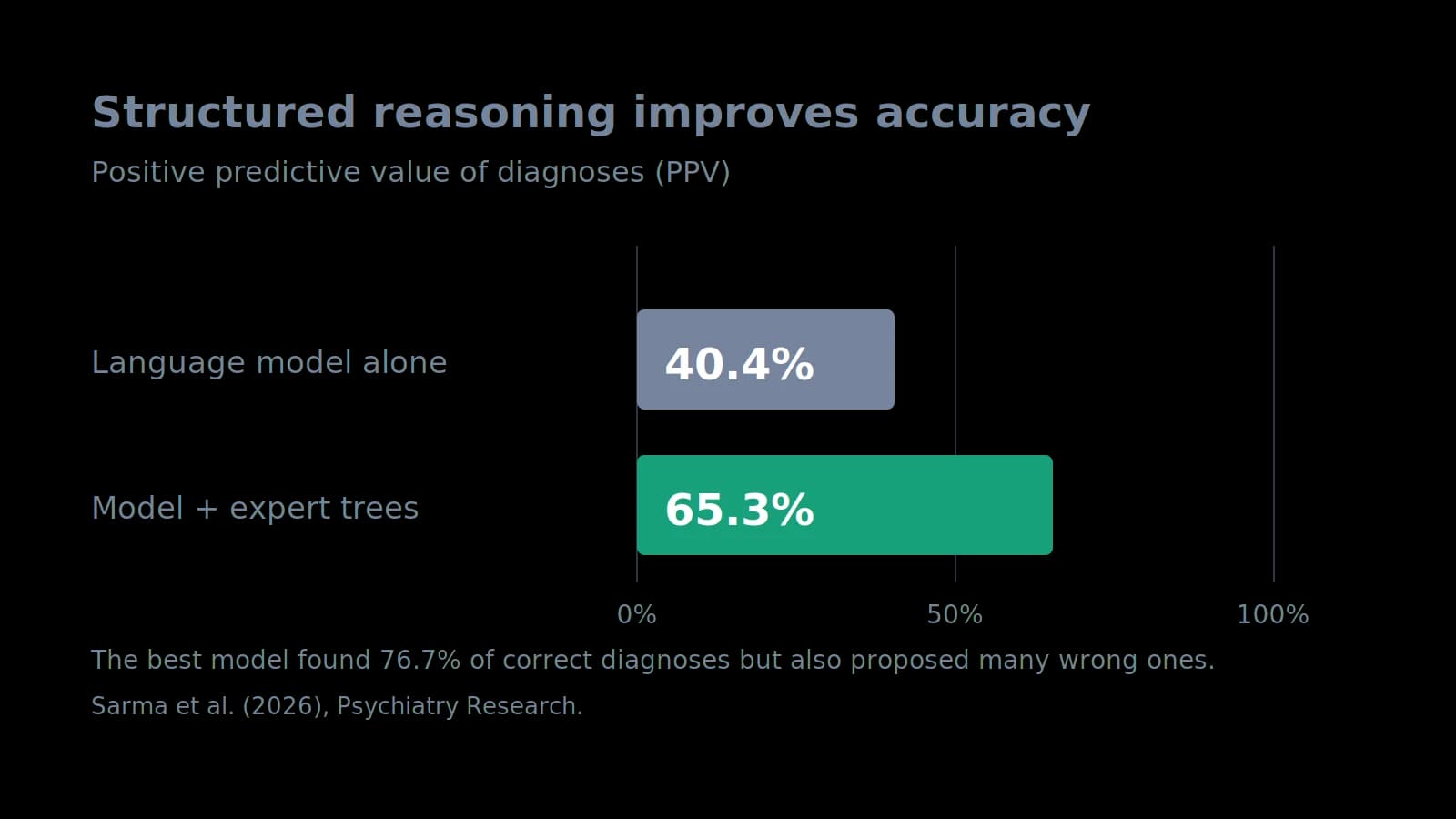
This shows how important structured diagnostic reasoning is. Noticing a similarity between symptoms and the description of a disorder is not enough. You also have to be able to judge whether a given diagnosis really is the best explanation of the observed difficulties.
This does not mean that AI will not get better at such tasks too. On the contrary, Sarma and colleagues show that using structured expert knowledge can improve the quality of model answers. All the more reason to think about how to develop your own diagnostic skills deliberately.
Is experience enough to diagnose well?
In everyday practice we often learn through successive encounters with patients. Over time we gain skill, recognise characteristic patterns faster and run interviews more smoothly.
At the same time, experience alone does not guarantee sound reasoning. We can also become fluent in entrenched ways of thinking that are not always helpful. For example, we attach ourselves to the first hypothesis too early, or we pay more attention to information that confirms it.
In diagnostic work, the ability to notice contradictions, look for data that challenges our own assumptions and tolerate uncertainty when the available information does not yet allow a diagnosis is especially valuable.
Such competencies can be practised deliberately.
The meta-analysis by Kononowicz et al. (2019), covering 51 studies and 4,696 participants, found that education with virtual patients can lead to better results in selected clinical skills than traditional teaching methods. The results varied a great deal, however, and the quality of the evidence was limited.
In turn, the systematic review by Gilbert et al. (2026), covering 11 studies, indicates that AI-supported patient simulations can help develop communication, empathy and clinical reasoning. We still do not know enough, though, about how far the skills gained in such exercises carry over to real work with patients.
Where can you practise differential diagnosis?
It was with developing these competencies in mind that we created Practicly, a clinical interview simulator that lets you practise conversations with virtual patients in a safe setting.
In Practicly, the point is not to guess the diagnosis as fast as possible. The user runs the interview independently, deciding what to ask, which information to explore further and which hypotheses are worth testing. After the session, they can review the course of the conversation, receive feedback and check which important areas were missed.
It is a chance to look at your own way of thinking. Do we focus too quickly on one explanation? Do we also ask about symptoms that may contradict our hypothesis? Can we spot information relevant to differential diagnosis?
You can try a free session in Practicly and see what your interviewing process looks like.
What is worth investing in in the age of AI?
We do not know what the market for diagnostic services will look like in five or ten years. We can, however, watch how tools that support the analysis of clinical data are developing.
Knowing the diagnostic criteria remains the foundation of the work. What may matter more and more is how we use that knowledge: whether we can form and test hypotheses, understand the complexity of a clinical picture and make decisions despite incomplete information.
It is also worth remembering that professional development does not end with getting qualified or with many years of experience. The chance to practise regularly, make mistakes and receive constructive feedback remains important at every stage of a career.
AI will probably change how we diagnose. We do not yet know which tasks will be automated, or to what extent. Regardless, the ability to analyse information critically, weigh different explanations and justify diagnostic decisions is something worth improving.
References
- Lenz, E., Naamanka, J., Trabert, W., et al. (2026). Benchmarking large language models against practicing clinicians on psychopathological assessment. npj Digital Medicine, 9, 518. https://doi.org/10.1038/s41746-026-02852-7
- Sarma, K. V., Hanss, K. E., Halls, A. J. M., et al. (2026). Integrating expert knowledge into large language models improves performance for psychiatric reasoning and diagnosis. Psychiatry Research, 355, 116844. https://doi.org/10.1016/j.psychres.2025.116844
- Kononowicz, A. A., Woodham, L. A., Edelbring, S., et al. (2019). Virtual patient simulations in health professions education: Systematic review and meta-analysis by the Digital Health Education Collaboration. Journal of Medical Internet Research, 21(7), e14676. https://doi.org/10.2196/14676
- Gilbert, V., Philip, P., Llorca, P.-M., & Samalin, L. (2026). Use of artificial intelligence-enhanced virtual patients in educational approaches to medical interview training: A systematic review. BMC Medical Education, 26, 588. https://doi.org/10.1186/s12909-026-08804-9
- National Institute for Health and Care Excellence. (2018). Attention deficit hyperactivity disorder: Diagnosis and management (NICE Guideline NG87). https://www.nice.org.uk/guidance/ng87